The instrument
What is a koto? The 13-string zither
How the koto is built, tuned and played, where it came from and what to watch for when a player sits down in front of you.
Reserve a seat at the concert ↗A zither on the floor
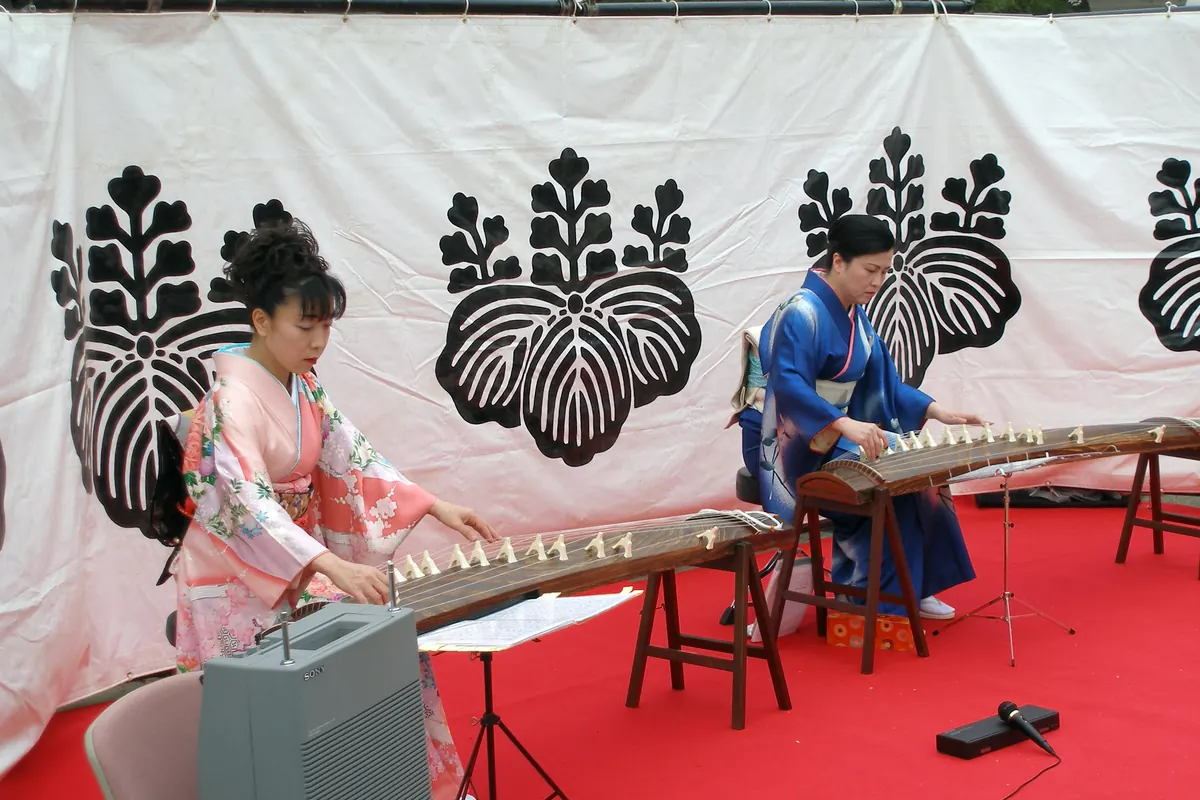
The koto is a Japanese plucked zither, a long, half-tube wooden body that lies on the floor while the player kneels in front of it. It is often described as the national instrument of Japan. It is about 180 centimetres long and made from paulownia wood, known in Japanese as kiri. The most common type carries 13 strings, and that is the instrument you will hear in a Kyoto concert.
Thirteen strings and movable bridges
All 13 strings run the full length of the body, and each rests on its own movable bridge, called a ji. Sliding a bridge changes the pitch of that string. Different pieces call for different tunings, so a player may reset the bridges between pieces, and during a concert you can watch this happen. The bridges are traditionally made of ivory, although today they are typically plastic or sometimes wood.
Picks and fingers
The player plucks with three finger picks, the tsume, fitted to the first three fingers of the right hand. Because the strings are plucked with picks rather than bare fingertips, the sound is bright and clear, and in a small room you can watch the picks catch each string, which is the best reason to sit close.
From China to the Japanese court
The ancestor of the koto is the Chinese zheng, introduced to Japan in the seventh and eighth centuries. The first known version had five strings, and it later grew to seven. The modern koto descends from the gakusō used in gagaku, the music of the Japanese court. It was an instrument of the wealthy and considered romantic: in The Tale of Genji, the hero falls for a woman after hearing her play it from a distance.
A Kyoto instrument
Kyoto's tourism board notes that the koto was an instrument of the aristocracy, developed and handed down through more than a thousand years of the city's history. The connection is more than ceremonial. Yatsuhashi Kengyō, the musician often called the father of modern koto, is described as being from Kyoto. His work took the instrument out of the court and into wider hands, which is part of why a koto can now be heard in a townhouse.
Thirteen, seventeen and more
A 13-string koto is the standard, but it is not the only size. The 17-string bass koto, created by the composer Michio Miyagi, plays the low register in ensembles and is common today. Longer versions have 20 strings or more. Another relative is the taishōgoto, an instrument whose buttons change the pitch of its metal strings. It is named after the Taishō period, which began in 1912, and it is one of the instruments that can join the koto in a duet.
What to watch for in the room
Watch the right hand first: the three picks, and how the player plucks a single string or sweeps across several. Then look at the bridges. Different pieces may need different tunings, so a player can reset the bridges between pieces, and you may see it happen. The shamisen, the other instrument on the programme, has a more percussive and buzzing sound, which makes a good contrast.
A family of zithers
The koto is one member of a wide Asian zither family. It derives from the Chinese zheng and se, and it resembles the Mongolian yatga, the Korean gayageum and ajaeng, the Vietnamese đàn tranh and the Kazakh jetigen. Within Japan, regional forms exist too: the tategoto from the Amami Islands is held upright on the lap and played with one hand. Hearing the Japanese version in a small room makes the family resemblance and the differences easy to notice.
How the concert uses it
In the townhouse concert the player performs solo sets on the koto and the shamisen, so the two instruments appear side by side. The bathhouse concert pairs the koto with a second instrument in a duet. In both rooms the introduction explains the parts and the unusual notation before the first piece, which makes the instrument far easier to follow once the music starts. If you want to try it yourself, the townhouse offers an optional beginner lesson.
Sources